Traditional ROI in the age of AI does not yet guarantee competitiveness.
Ask what a company’s AI programme has delivered and the answer usually arrives in savings, hours and adoption rates. Ask what the company can now do that its competitors cannot, and the answer takes longer to assemble.
The distance between those two answers is not a reporting problem. It is set much earlier, in the business case that every AI investment has to pass before it is given money.
What AI can produce is not limited to running the present business more cheaply. The same capability can change what a company offers and to whom, and that is where an advantage lasts.
That is also the harder of the two to prove before the money is spent.
Strategy is where AI ambition is set. Capital approval is where it is settled, and the business case reads some forms of value far more easily than others.
Two Proposals, One Capability
Two AI proposals reach the same committee on the same morning. Both are built on the same new capability.
The first lowers the cost of a process the company already runs. It arrives with a baseline, a calculated return and a short payback period.
The second is aimed at customers. Its value would arrive later, build gradually, and hold for longer once it did.
Both are considered seriously, and the difference is what each one can show on the day of the decision. One proposal is certain and familiar. The other only looks like potential.
Nobody in that room has to prefer the cost proposal for it to be the one that passes.
Every Form of Value Reaches Somebody
Value is not one thing. Every form of it names a recipient, the party where the benefit occurs.
Cost reduction occurs inside the company. Nobody outside has to act differently for the saving to appear.
A company can pass part of that saving on as a lower price, and then somebody outside is better off too. That is a second decision, taken after the saving already exists, and it is not the decision the cost case was approved on.
Revenue growth is not like that. Revenue arrives only through a customer, so revenue growth names the customer as a recipient alongside the organisation.
The AIVaaS™ Value Spectrum sets these forms out in order and names the recipient of each one. Further along it lists value-driven productivity, customer and employee experience, new revenue streams, market share and margin expansion, equity growth, and net positive impact.
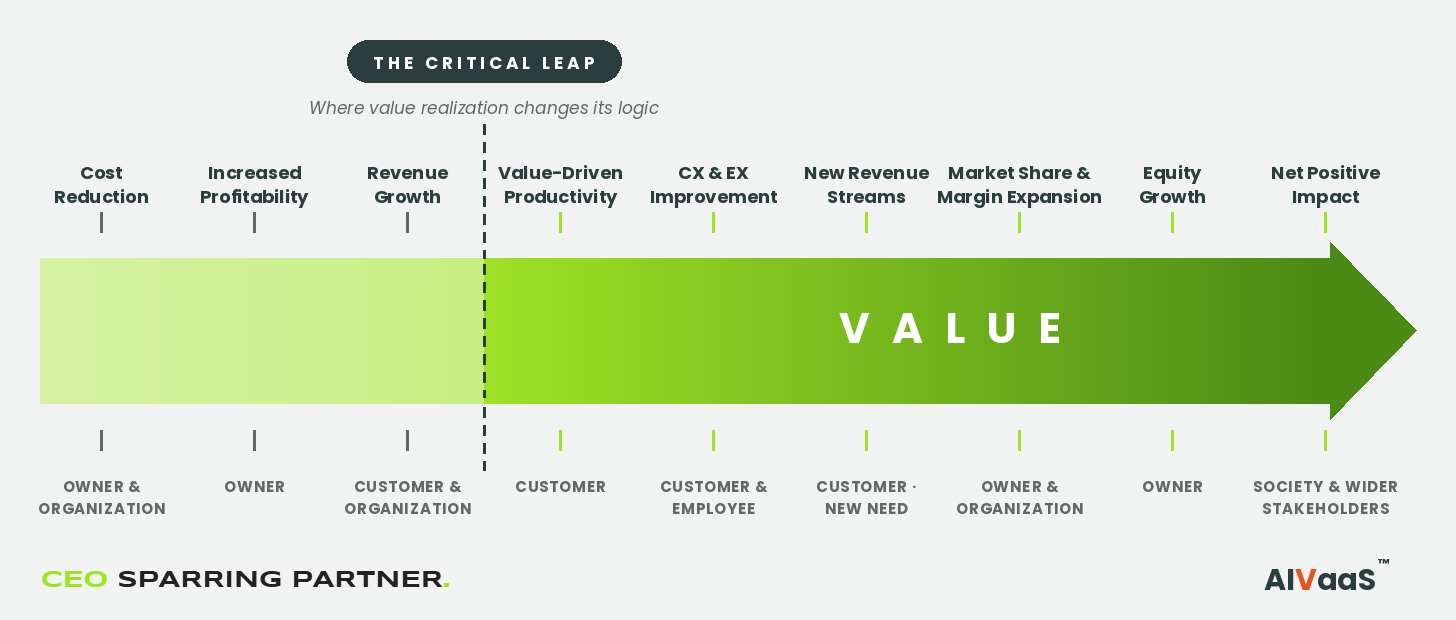
A third of the way along the spectrum sits the Critical Leap. To the left of it, value comes from the business you already have, performing better, and it shows up on a line that already exists in your accounts.
To the right of it, value reaches the business only after it has reached somebody else. A customer has to be better served, or an employee has to work differently, before anything arrives on your side.
The Same Capability Can Go Either Way
An AI capability has no direction of its own.
Point it inward and it does the work you already do faster and at a lower cost, with fewer manual steps, shorter cycles and more cases handled in a day. This is productivity of execution, and it is real value.
Point it outward and the same capability does something else. It finds a need nobody is covering yet, and it makes possible an offer the company could not have made before.
AIVaaS™ calls the second one value-driven productivity. It measures how many new business models you can design, test, reject and scale, and how quickly, with each one able to open a new form of value.
Most of what AI can produce sits to the right of the Critical Leap.
AI does not arrive with a purpose attached. Somebody gives it one, and the last word on that purpose belongs to whoever approves the money.
One Arrives With a Calculation, the Other With a Claim
A business case exists to make different proposals comparable, and it has done that job well for decades.
Comparability needs a baseline. Cost reduction has one, because the cost already exists and the company already measures it.
The customer-side proposal has no baseline. It rests on a judgement about whether a need outside the company will be met, and by how much.
In most organisations the business case is read as its return. The number is what gets quoted, and the pages behind it are not the pages that get read out.
That reading holds for as long as AI is treated as a cheaper way to run the business you already have. Once the full range of what AI can change is in view, the business case has to carry more than a return.
To the left of the Critical Leap the return can be calculated with confidence. To the right, the same calculation needs an assumption about somebody outside the company, so it comes as a range rather than a figure, and the range is the honest answer.
So one proposal arrives with a calculation and the other arrives with a claim, and nothing in the business case prepares it to weigh the second against the first.
This is not one company’s habit. Deloitte’s Finance Trends 2027 survey found that 36 percent of finance leaders cite time and productivity as the key metrics for evaluating AI investments, compared with 23 percent who cite revenue enablement.
The report names the limit itself and calls for a fuller view of value, without saying what fuller would contain.
The Filter Does Not Reject, It Teaches
The company commits to an AI ambition. The portfolio fills with the investments that clear the bar most easily. A year later the portfolio carries a smaller ambition than the strategy did.
Nobody voted against the AI ambition. There was no vote.
The second effect costs more, because people learn what passes. After a few rounds, nobody writes the proposal that will not be approved, and the narrowing moves into documents that are never drafted.
When a CFO Question Becomes a CEO Decision
Deciding which AI investments get money looks like a finance question, and in many ways it is.
The standard view in finance is understandable, and a company needs it. A CFO is accountable for capital the company has already earned, and the discipline is to protect it, to make unlike proposals comparable, and to stop a good story from spending real money.
That standard also carries a theory of competitive advantage inside it. For decades the advantage came from running an existing operation better than rivals ran theirs, and technology investment served that directly.
The value landed on a line the company already measured, and a return calculated on that line described the investment accurately.
Two things have changed. The efficiency AI buys is on sale to every competitor, so the advantage it produces is competed away faster than it used to be.
The durable part of what AI can do sits where a return on an existing line cannot reach.
So criteria that once selected for advantage now select for the part of AI that lasts the shortest time. That is the leap, and it is not only the company’s. It is the CFO’s as well.
Inside the organisation the evidence for value already exists, and the work is to read it correctly. Outside the organisation nobody is collecting it yet, so the evidence has to be designed before the investment starts.
That changes when finance has to be in the room. A return that can only be evidenced from outside cannot be assembled at the end, while the proposal is being written. It has to be agreed at the start, while the initiative is still being shaped.
None of this asks for a lower standard. It asks for a second standard next to the first, for the proposals the first one cannot read, and adding it widens the craft rather than criticising it.
Finance will not reach past the boundary of the organisation on its own, and it should not have to. What a customer will value, and which of that value will last, is a judgement about the company’s position in its market rather than about its capital.
That judgement is the CEO’s, and so is the decision to have it written into the criteria finance applies.
The same goes for the mix. Some AI initiatives belong on the left of the Critical Leap, because margin has to hold and those savings fund everything else.
The ones that make a company harder to replace sit on the right, so a portfolio weighted heavily to the left is a decision about how long the company intends to stay distinct.
That decision appears in no business case. It appears only in the composition of the whole portfolio, and holding the portfolio against the declared ambition is the CEO’s job.
Approved Is Not the Same as Competitive
Cost savings are value. They protect this year’s margin and they fund everything else.
What they do not do is make the company different from anyone else.
The AI that lowers the cost of work a company already does is a product. It is sold to that company’s rivals too, at a similar price, and installed on a similar timetable. Whatever advantage the first mover holds lasts until the others finish the same project.
That is what commoditisation looks like while it is happening. The cost base of the whole industry falls, every participant books a real saving, and nobody’s position relative to anyone else has moved.
The saving is real. The advantage is temporary.
A portfolio full of such savings lowers costs every year and leaves the company selling exactly what it sold before. Every one of those investments was approved on sound reasoning, and every one of them returned what it promised.
A return measures how well the money was spent. It does not measure whether the company became harder to replace.
Cost savings hold this year’s margin. They do nothing about the reason a customer will still be a customer next year.
Creating that reason is a choice about what the company will offer, to whom, and how it will capture part of the value in return. Those are the choices that shape a business model, and they are the CEO’s.
The company’s books record the consequence of customer value, never its cause. Reading them tells you what a customer did last year, not what would make them stay next year.
That is not an error of arithmetic. It is an error of horizon.
What the CEO Can Change
Overruling individual decisions is not the lever. It costs authority and changes nothing about the proposal after it.
The lever is what a business case has to say before anyone judges it, and widening that is help the CFO cannot give himself. Three additions do most of the work, and none of them lowers the bar.
Ask every proposal to name who outside the company has to be better off. When nobody is named, the investment is an internal one by default, because internal value is the kind the company’s own systems already record. Naming the recipient tells finance where else to look.
Ask for the portfolio, not only the proposal. A CFO judging proposals one at a time cannot see the mix, and the mix is what decides whether the AI ambition survives the year.
Ask what evidence would change the decision. An investment approved on a claim needs a date when the claim is tested and a consequence attached to the answer: scale, redesign or stop. That is discipline finance already knows, applied where it has not been applied before.
One more thing helps, and it is not a document. What counts as value for a customer, and which of it lasts, is knowledge the CMO works with every day and the CFO now needs. Only the CEO can require the two of them to arrive in the same proposal.
The Question Before the Money Moves
When the next AI investment reaches the executive team, the usual questions will be asked. The team will want to know what it will cost, how quickly it can be delivered, how many people will use it, and what internal improvement it will produce.
Those questions still matter. One question should come before them.
Beyond the return, what will this investment give a customer that a competitor cannot easily match?
If there is a clear answer, the investment can be judged on what it is trying to do rather than on what it happens to be able to prove.
If the honest answer is that it will make the company cheaper to run, the investment is an internal improvement. Some of those are necessary and some are overdue.
Asking it does not make the customer-side proposal win. A company can weigh both sides and still fund the saving, for good reasons, in a given year.
What changes is that the choice is made rather than inherited. Nobody voted against the AI ambition the first time, and asking that question before the money moves is how it gets a vote.