Meaningful AI value is tied to customer needs
There is a familiar pattern in many executive conversations about AI. At first, the discussion sounds responsible, practical and business-oriented. Leaders ask where time can be saved, which processes can be automated, how much productivity can be gained, which costs can be reduced, and which employees should be trained first.
These are not the wrong questions. Every serious organization should ask them. AI can reduce manual work, accelerate analysis, improve internal workflows and help people perform certain tasks faster and better. It can remove waste from processes that have been too slow, too fragmented or too dependent on individual effort for too long.
But there is a problem when this becomes the whole conversation.
If AI is measured mainly by internal improvement, the organization may become better at doing what it already does. It may move faster, produce more and remove certain inefficiencies. Yet none of this automatically means that the business has become more valuable in the eyes of customers, markets or future investors.
The deeper question is not whether AI has improved internal activity. The deeper question is whether AI has improved the value the business creates for someone outside the system.
This is where many CEOs may be looking in the wrong direction.
Why the Comfortable Side Feels So Rational
There is a reason why most organizations start with internal performance. It is the part of AI value that feels easiest to manage. It can be translated into hours, costs, capacity, adoption rates and productivity indicators. It fits the language of budgets, business cases and quarterly performance reviews.
For many leadership teams, this is also the safer place to begin. It does not require the company to challenge its business model. It does not immediately force difficult questions about customer relevance, competitive differentiation or the future shape of the organization. It allows AI to be introduced as an improvement to the existing system rather than as a question about what the system should become.
That is why this starting point is not only understandable. In many companies, it is necessary. Operational value creates credibility. It helps people see that AI is not just a concept or a trend, but something that can improve real work.
The risk appears when this rational starting point becomes the boundary of ambition.
A company can become more efficient without becoming more distinctive. It can improve internal performance without creating a stronger reason for customers to choose it. It can appear active in AI while still leaving the deeper business opportunity untouched.
This is why many AI initiatives remain useful, but strategically limited. They improve the organization’s motion, but they do not yet change the value the business creates.
The Direction of Value Matters
The first direction of AI value looks inward. It asks how the organization can improve its existing system. This direction matters because every business must protect its performance. A company that ignores operational discipline will eventually lose room to invest, innovate and compete.
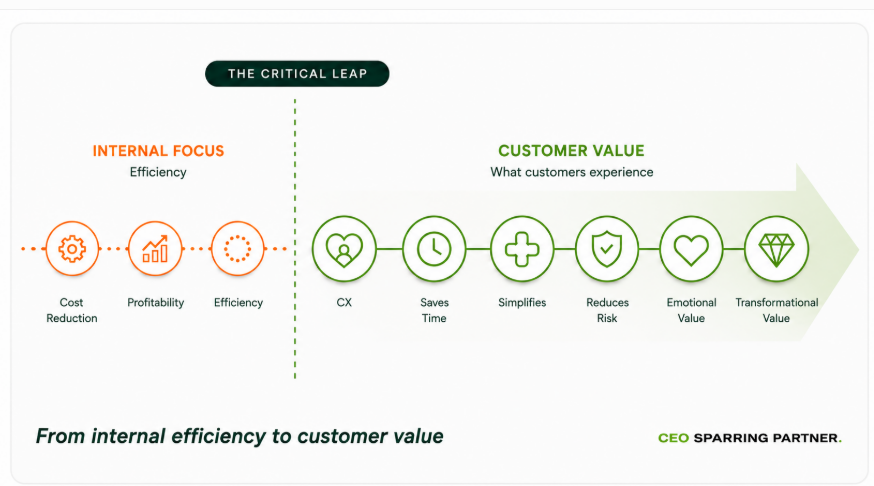
But there is another direction of value. It looks outward. It asks what becomes better for customers, markets and the business model because AI is now part of the business.
This is where the real strategic shift begins. Not the shift from no AI to AI, but the shift from AI as an internal improvement tool to AI as a value creation capability.
That is the critical leap.
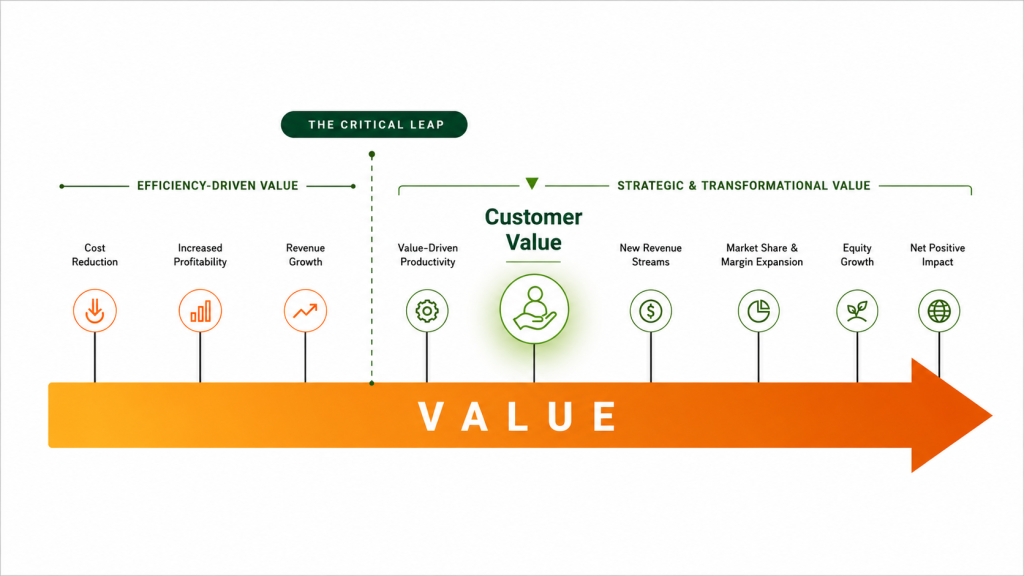
The visual captures the difference well. On the left side are value outcomes that most organizations already understand and can usually manage through existing performance logic. On the right side are outcomes that require a broader ambition: value-driven productivity, customer and employee experience improvement, new revenue streams, market share and margin expansion, equity growth and net positive impact.
The arrow is not simply moving from left to right. It is moving from a narrower definition of value to a broader one.
Output Is Not the Same as Effect
One of the reasons this shift is difficult is that organizations are used to measuring visible activity. They measure produced outputs, completed tasks, automated steps, adopted tools and reported usage.
These metrics are useful, but they are not enough.
Output tells us that something happened. Effect tells us that something changed.
A company can answer customer requests faster and still fail to solve the real customer problem. It can generate better reports and still not improve executive decisions. It can automate a process and still leave the customer experience almost unchanged. It can produce more content, more analysis and more communication without creating more meaningful value.
This distinction becomes even more important as AI makes production cheaper. When it becomes easier to generate text, code, summaries, presentations, recommendations and workflows, the fact that something was produced becomes less impressive. The more important question is whether the result created a meaningful change.
This is where value begins to separate from motion. Not in the volume of activity, but in the effect that activity has on a customer, an employee, a decision, a relationship or a market position.
Where Effect Becomes Customer Value
The most demanding test of AI value is not internal confirmation, but external evidence. It is not enough to show that an AI initiative produced more, accelerated work or improved an internal process. The more important question is whether the effect of that initiative becomes visible and valuable to someone outside the organization.
This is where customer value enters the conversation.
A better internal process matters more when it improves the customer journey. A faster decision matters more when it reduces customer risk or increases confidence. Better data matters more when it enables a more relevant offer, a more precise service or a more valuable relationship.
In other words, the effect of AI becomes strategically meaningful when it connects with a real customer need and is perceived by the customer as value.
This does not mean that every AI initiative must directly touch the customer. Some initiatives will remain internal, and some of them will be necessary. But if the organization cannot explain how its AI efforts ultimately improve customer relevance, customer experience, customer confidence or customer outcomes, then the strategic value remains incomplete.
For many companies, this is the missing connection. They can describe what AI does internally, but they cannot yet describe what becomes better for the customer because of it.
When a CMO Question Becomes a CEO Decision
At first, this may look like a CMO question.
And in many ways, it is. Customer needs, perceived value, experience, positioning, relevance and market signals are all areas where the CMO should bring an essential perspective. If AI is expected to create value beyond internal improvement, the company must understand what customers actually need, where they experience friction and how their expectations are changing.
This is also where AI can become especially powerful. It can help detect weak signals in customer behavior, reveal patterns in feedback, compare promised value with perceived value and uncover emerging needs that are not yet visible in traditional reporting.
So yes, the CMO should be deeply involved.
But the question does not stop there.
Understanding customer needs is not the same as deciding what value the company will create. Recognizing perceived value is not the same as choosing the business model through which that value will be created, delivered and captured.
That is where the question becomes a CEO decision.
Durable differentiation does not come from AI itself. It comes from customer value that competitors cannot easily match, and from a business model that can create, deliver and capture that value better than others.
Sometimes this means creating a form of value competitors cannot easily provide. Sometimes it means delivering existing value better, faster, more personally, more reliably or at greater scale. Sometimes it means removing friction that customers have learned to tolerate because the market has not yet offered a better alternative.
These choices shape the business model. They influence which capabilities need to be built, which processes must change, which data matters, which partnerships become important and which technologies deserve investment.
The CMO can help the organization understand the customer and the market. AI can make that understanding richer, faster and more precise. But the CEO must connect that insight with the strategic choice of what the company wants to become.
That is why the customer question may begin with the CMO.
But it becomes a CEO decision when it determines the value the company will create for customers, how it will deliver that value better than others, and how it will capture part of that value for itself.
From AI Activity to Value Capture
This also changes what belongs on a CEO-level view of AI.
Usage, adoption and project progress still matter, but they should sit below a more important layer: evidence that AI is changing customer outcomes, removing business constraints and strengthening the business model.
This is the difference between AI activity and AI value capture.
Activity proves that the organization is moving. Value capture proves that the business is becoming stronger because of it. The first is a necessary signal of progress. The second is evidence of strategic impact.
This does not mean that every AI initiative must be transformational. Some should be simple, operational and focused on improving today’s work. But the portfolio as a whole should not stop there.
Some AI initiatives will improve the current operating model. Others should improve customer experience, employee experience, decision quality or market relevance. A smaller number may create new revenue streams, new services or even new business models.
The danger is not that leaders start with internal improvements. The danger is that they never move beyond them.
The Final Question
The next time an AI initiative is presented to the executive team, it may be tempting to begin with the usual questions: how much it will cost, how fast it can be implemented, how many people will use it and what internal improvement it will deliver.
These questions still matter. But one question should come earlier:
What customer need will this help us serve better, in a way the customer will actually perceive as value?
This is not really two separate questions. It is one question with two sides. The first side asks whether the initiative is connected to a real customer need. The second asks whether the customer will actually notice, experience or value the improvement.
That question changes the conversation. It moves AI from a discussion about tools, tasks and internal performance to a discussion about relevance, value and the future position of the business.
If the answer is clear, the AI initiative may deserve serious strategic attention. If the answer is not clear, it may still be a useful experiment, an operational improvement or a learning opportunity. But it is not yet a value creation initiative.
In the end, AI does not create strategic value simply by making the organization more efficient. It creates strategic value when it helps the business become more valuable to the people and markets it serves.
That is the question the CEO should make sure is asked first in the boardroom.